



12 Nov Australia’s Migration Programme Hasn’t Shrunk. The Signals Beneath Have Changed
- Australia’s permanent migration programme remains unchanged, but the distribution of those places has shifted significantly towards employer-sponsored pathways
- The bigger adjustment is taking place outside the permanent programme, with Net Overseas Migration forecast to decline over the coming years
- For employers, investors and workforce planners, the key question is no longer how many migrants Australia admits. It is whether the pathways their workforce depends on are expanding or contracting
Beyond the Headline
Migration policy is a planning input as much as a policy question. Hiring decisions, project timelines and growth assumptions all rest on a view of whether overseas talent will remain accessible.
That is why the 2026-27 programme deserves a closer look than its headline invites.
For employers and workforce planners, the practical question is not whether migration has changed. It is how those changes affect access to labour.
What Changed?
Australia’s permanent migration programme remains at 185,000 places, with 132,240 allocated to the Skilled Migration Programme (part of the migration programme intended to improve the productive capacity of the economy and fill skill shortages in the labour market)
Within that Skilled Migration Programme, however, priorities have shifted.
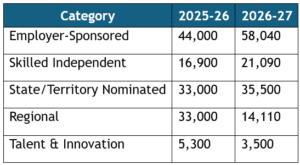
The overall Skilled Migration programme has barely changed. What has changed is where the places are going. Employer-sponsored visas have increased significantly, while regional migration allocations have been cut by more than half.
In other words, Australia has not substantially expanded skilled migration opportunities. It has redistributed them.
The other notable shift sits outside the permanent programme. Net Overseas Migration is forecast to fall from 295,000 in 2025-26 to 245,000 in 2026-27 and 225,000 in 2027-28. Temporary migration settings have also become more restrictive, including higher Temporary Graduate visa application charges.
What Most People Are Missing
Two employers operating in the same industry may experience very different outcomes, depending on whether they can sponsor workers, access state nomination routes or recruit from onshore talent pools.
There is also a longer-term trend worth watching.
A large proportion of permanent migration places are allocated to people already living in Australia. If temporary migration slows over time, the pool of candidates available to transition into permanent pathways may eventually become smaller as well.
The timing and extent of any impact remain uncertain, but it is a factor that organisations relying heavily on international talent may wish to monitor.
ConsultGenics’ View
The most interesting shift is not the migration number itself. What appears to be emerging is a more targeted migration system, where access increasingly depends on the route through which a candidate enters the system.
For employers, this changes the nature of workforce risk.
Historically, the question was often whether enough migrants would enter the country overall. Increasingly, the more relevant question is whether an organisation has access to the migration channels that are being prioritised.
From that perspective, Australia’s approach looks less like a reduction in migration and more like an attempt to steer migration towards areas of perceived workforce demand.
What This Means for Businesses
Employers
Employer-sponsored pathways have become more important. Organisations that already have sponsorship capability may be better positioned than those relying on regional or indirect pathways.
Investors
Labour availability is becoming an important investment risk. If businesses struggle to attract and retain workers, scarcity can also push wages up and squeeze profitability. Investors may need to revisit growth and cost assumptions accordingly.
Workforce Planners
Don’t just track migration numbers. Track migration pathways. Understanding which visa routes your workforce relies on may be more important than knowing the overall size of the migration programme.
Infrastructure and Project Developers
Labour shortages can delay projects and increase costs. Government measures to bring in skilled workers may help, but organisations should not assume they will fully solve workforce shortages.
What to Watch Next
- Details of Australia’s proposed migration points test redesign
- Whether Net Overseas Migration follows the government’s forecast path
- The impact of higher graduate visa charges on application volumes
- Changes to state and territory nomination priorities
- How quickly skills-recognition initiatives translate into additional workforce capacity
Why it Matters
At ConsultGenics, we look beyond policy announcements to understand their business implications.
Migration settings influence labour availability, recruitment costs, workforce planning, project delivery and growth assumptions. For organisations operating in labour-intensive sectors, changes to migration pathways can affect decisions far beyond immigration compliance.
Viewed through that lens, migration policy becomes a business issue as much as a policy issue.
How ConsultGenics Can Help
Policy changes rarely affect every organisation in the same way.
An employer, an investor and an infrastructure developer may all be exposed to the same reform, but for different reasons.
ConsultGenics helps organisations understand how policy and regulatory developments affect workforce availability, market dynamics, operating conditions and investment assumptions.
Our work includes:
- Policy and regulatory intelligence
- Labour market and workforce analysis
- Market and sector assessments
- Economic and business environment research
- Growth and strategy studies
If these developments could affect your workforce strategy, hiring plans, investment assumptions or market outlook, we would welcome a conversation about the implications for your organisation.
No Comments